These courses cover sacred knowledge sent down by Allah, along with the foundational skills a student needs to study and understand it. They focus on the Holy Qur'an and its deeper meanings, core beliefs, acts of worship, and Islamic character. They also include the study of the Arabic language in which the revelation was sent. All subjects are taught in structured levels, making them accessible to everyone from absolute beginners to advanced students.
General Academics (al-ʿilm al-ʿaqlī)
These courses cover knowledge developed through human effort, discovery, and critical thinking. They focus on subjects built around reading, mathematics, scientific testing, and observation—including literature, geography, history, and art. All subjects are taught progressively by grade level, starting from kindergarten and moving upward.
81 of 81 courses · 52 coming soon
Islamic & Arabic Studies (al-ʿilm al-naqlī)
Bunyān Arabic
Graded Arabic language program
Bunyān Arabic — Level K
In Level K, students begin reading the Arabic script by learning the twenty-eight letters of the alphabet. They practice recognizing the shapes and sounds of each character. The course introduces the three short vowels, known as fatḥa, kasra, and ḍamma. Finally, learners practice blending these sounds to read their first complete words and join letters together.
This Level 1 class teaches the rules for reading the Quran. Students practice double vowels, silent letters, and closed syllables. They look at special marks like the shaddah and small letters found in the script. By the end of the year, the class reads short chapters directly from the text while applying basic pronunciation rules.
Level 2 introduces basic Arabic grammar and vocabulary for everyday communication. Learners practice forming two-word sentences, asking questions, and describing objects. The lessons cover masculine and feminine words, past tense verbs, and prepositions of location. Students also learn how to express possession, count to ten, and use plural forms for people and things.
This course teaches verbs in the past, present and future tenses. Students learn to use pronouns, prepositions, numbers and passive verbs. They also study sentence grammar and read longer passages.
This course explains conditional sentences and nouns in the dual and plural. Students identify the subject, predicate and object of a sentence. They also study adverbs of time and place and read longer passages on their own.
Level 12 is the capstone course in Bunyān Arabic and adds no new grammar. It covers whole surahs, classical prose, comparing translations, a seminar and a project.
Islamic studies in seven levels. One chapter per page.
Shajarah — Level 1: Nabt (Sprout)
Nabt, the seedling. Level 1 introduces students to the major prophets and righteous figures in Islamic history. They study the lives of messengers from Adam to Muhammad, understanding their trials and steadfastness. The course covers key individuals like Maryam, Luqman, and the People of the Cave, providing a foundational knowledge of prophetic history and character.
Aṣl, the root. In Level 2, students focus on the oneness of Allah and the nature of divine revelation. The material explains how the Quran serves as a preserved criterion for humanity. Students also examine practical ethics, learning how to maintain justice, practice modesty, and settle disagreements fairly within their families and communities.
Sāq, the stem. Level 3 connects internal faith with outward actions. Students examine the purpose of creation, the importance of sincerity, and the mechanics of personal accountability. The text details how prayer, remembrance, and reflection shape character, while emphasizing that true righteousness relies on piety rather than social status or tribal affiliation.
Designed for ages 13 and 14, Jidhʿ focuses on building the moral self. Students turn inward to clear their hearts and train their emotions. They then take these inner ethics outward into their relationships and civic life. Every chapter is built on the Qurʾān and ends with a quiz.
Furūʿ, the branches. Students in Level 5 study the foundational concepts of the religion, including the natural disposition of humanity and the finality of prophethood. They review the pillars of worship, such as fasting and pilgrimage. The lessons also address spiritual health, showing how to cure diseases of the heart and build excellent character.
Thamarāt, the fruit. In Level 6, students evaluate the development of Islamic scholarship and society. The course traces the era of the early caliphs, the expansion to Damascus, and the intellectual movements in Baghdad. Students learn how scholars preserved texts, reasoned through evidence, and maintained resilience during fragmentation.
Ḥiṣād, meaning the harvest, is the seventh and final level of the Shajarah series for ages 18 and up. This course places the Book of Allah in your hands as the only legislative authority in the dīn. You will learn a complete method to read the Qur'an as one coherent message, asking: in what statement after Allah and His verses will you believe?
The name Āfāq comes from the Arabic word for horizons in Qur'an 41:53. This series is a theme by theme tafseer, or explanation of the Qur'an, covering Sūrah al-Fātiḥah and the sūrahs of Juz ʿAmma.
Āfāq — Volume 1 · Knowing Allah
This volume teaches tafseer, the explanation of the Qur'an, on who Allah is and the worship owed to Him alone. Students explore these meanings through the sūrahs al-Fātiḥah, al-Ikhlāṣ, al-Kāfirūn, Quraysh, and al-Bayyinah.
This volume presents tafseer on the human being and the soul. Students study these themes through at-Tīn, al-ʿAṣr, al-ʿĀdiyāt, ash-Shams, al-Aʿlā, and al-Fajr.
This volume covers tafseer on the Day of Judgement. Students learn these lessons through az-Zalzalah, al-Qāriʿah, aṭ-Ṭāriq, al-Infiṭār, al-Inshiqāq, at-Takwīr, al-Ghāshiyah, an-Nabaʾ, and an-Nāziʿāt.
This volume explains tafseer on wealth and what is owed to people. Students examine these topics through at-Takāthur, al-Humazah, al-Māʿūn, al-Layl, al-Balad, and al-Muṭaffifīn.
This volume focuses on tafseer on the message and the one who carries it. Students study this guidance through al-ʿAlaq, al-Qadr, aḍ-Ḍuḥā, ash-Sharḥ, ʿAbasa, al-Kawthar, and an-Naṣr.
This volume explores tafseer on Allah's protection and seeking refuge in Him. Students learn these meanings through al-Fīl, al-Burūj, al-Masad, al-Falaq, and an-Nās.
The name Tibyan comes from the Arabic word for a clear explanation in Qur'an 16:89. This series teaches what the surahs mean in simple English, grade by grade starting from Grade 1.
Tibyan — Grade 1
This course teaches the meaning of ten short surahs memorized in Qur'an class. Students see the Arabic verses and listen to clear English explanations read aloud.
This course teaches the method of reading the Qur'an for its legal rulings and classifying what it finds. You will learn how to read the Qur'an, weigh different commands, and arrive at clear guidance.
This course teaches what Allah commands and forbids regarding purification and prayer by examining every relevant verse of the Qur'an together. It separates what Allah requires from what people have added and what Muslims commonly practise. It also answers the strongest objections from the Qur'an.
This course teaches you to memorise the Qur'an. You will listen to a reciter, read the verses with tajweed rules, and hide the words to practice from memory. A teacher will set daily portions and mark your recitation.
Mathematics, grades 2 to 6. Each lesson is one page with worked examples and a graded problem set.
Spectra Math — Pre-K
This course explores numbers from zero to ten, basic shapes, and two part patterns. Children look at sizes such as big, small, tall, short, heavy, and light. They also practice sorting objects into groups, putting together, taking away, and recognizing a dollar and a quarter.
Kindergarten students begin their mathematics education by focusing on basic numbers. They practice counting objects and writing numerals from zero up to seven. The course builds a strong foundation in number recognition and sequencing, helping students understand basic quantities and prepare for more advanced arithmetic in later grades.
First grade mathematics introduces addition and subtraction facts up to one hundred. Students learn about place value by counting and writing numbers up to forty-nine. The course also covers reading clocks to the half hour and identifying, drawing, and composing various two-dimensional and three-dimensional geometric shapes.
This second grade course expands on foundational arithmetic by teaching two-digit addition and subtraction, including renaming. Students work with three-digit numbers up to nine hundred ninety-nine, practice skip counting, and determine odd or even values. They also measure length in inches and centimeters and tell time to the quarter hour.
In the third grade level, the focus shifts to multiplication and division facts alongside four-digit addition and subtraction. Students study fractions on a number line and compare equivalent parts. They calculate area, measure volume and mass, classify quadrilaterals, and solve basic number sentences to prepare for later algebra studies.
Fourth grade math covers numeration up to one million and operations with five-digit numbers. The course includes multi-digit multiplication and division, as well as finding equivalent fractions and adding fractions with like denominators. Students also measure weight and liquid volume, identify symmetrical shapes, and classify different types of angles.
During fifth grade, mathematical concepts include operations with decimals and fractions with unlike denominators. Students learn to multiply and divide mixed numbers and use the order of operations to evaluate mathematical expressions. The material also covers calculating volume, converting standard measurements, and plotting ordered pairs on coordinate grids.
Sixth grade mathematics transitions into pre-algebraic concepts by introducing ratios, rates, percentages, and integer operations. Students solve one-step equations and write equivalent expressions using exponents. They apply these numerical skills to geometric formulas, calculating the area of polygons alongside the volume and surface area of three-dimensional rectangular solids.
This course covers adding and subtracting rational numbers, as well as multiplying and dividing rational numbers. Students work with expressions, equations, inequalities, and ratios and proportional relationships. They also study geometry, statistics, and probability.
In this course, students work with integers, exponents, and rational and irrational numbers. They also study linear equations and functions. The course includes geometry, statistics, and probability.
This course teaches letters from A to Z and their sounds. Children practice listening for sounds through rhyming words and making rhymes. They also clap word parts, find matching first sounds, and see how two words make one.
Kindergarten students start by learning individual letter sounds and their corresponding names. They progress to blending these basic sounds to read simple words, short phrases, and rhymes. The course also introduces common consonant combinations like ch and sh, along with everyday sight words to help them read basic sentences.
In Grade 1, students expand their phonics skills by exploring long vowel sounds and alternative spelling patterns for familiar consonants. They practice reading texts featuring new sight words and basic grammar concepts, including proper nouns, verbs, and contractions. This level focuses on increasing reading fluency and understanding different spelling rules.
Reading, grades 2 to 5. One passage per chapter, read on screen.
Spectra Reading — Pre-K
This course introduces print awareness, colors, and picture clues through stories. Children explore reading from left to right and top to bottom while learning position words like near, far, in, and out. They also hear stories about family, home, feelings, and sharing.
In this Grade K reading course, students practice early literacy skills through simple stories. They read about daily activities like going to the park, flying kites, and picking apples. The material introduces a character named Max, helping beginners follow his actions as he plays, jumps, and digs in the garden.
First grade students build reading comprehension by following narratives about animals and families. They read a story about a duckling finding dinner and follow Zehra as she asks her mother for a pet. The texts also introduce factual information about various states across the country, including Alaska and Vermont.
This course teaches students how to understand a character's feelings, identify cause and effect, and work out new words from surrounding sentences. Students learn to put events in order, recognize what a text is mostly about, and tell fact from opinion. They practice with short passages, stories, and nonfiction about a visit to the zoo, baseball, and how cotton becomes clothing.
This course teaches students to understand how a character feels, find reasons given in a text, and tell fact from opinion. Students also learn to work out a word from the meaning the sentence gives, track cause and effect, and identify the main idea of a paragraph. They develop these abilities by reading short stories and nonfiction passages about topics such as pitching a tent, volcanoes, and caring for a class hamster.
This course gives students tools to identify character traits, match idioms to their meanings, and distinguish dialogue from the words around it. Students also learn to find the reasons a text gives, compare two things in one article, and follow cause and effect. They strengthen these abilities by reading short stories and nonfiction selections about topics such as training a foster puppy, the history of jazz, and Mars.
This course gives students essential comprehension skills to recall details, identify character traits, and determine the author's purpose. Students learn to find word meanings in context, read charts and data, and locate the exact sentence that proves an answer. They explore these skills through short passages, stories, and nonfiction covering Australian wildlife, green roofs in cities, and space observatories.
This course teaches students to find the main idea, choose the best summary, identify the author's purpose and persuasion, tell fact from opinion, understand cause and effect, compare and contrast, and put events in order. Students also learn to recognize setting, climax, and theme, tell fantasy from a story set in real life, determine word meanings from Latin and Greek roots, and interpret similes, idioms, and hyperbole. These reading skills are developed through short stories and non-fiction passages about lighthouses, bats, bird migration, the Everglades, and the photographer Ansel Adams.
This course gives students practice in citing evidence from the text to support an answer, writing a one-sentence summary, finding the main idea, and evaluating an author's purpose, point of view, and balance. Students also learn to evaluate text organization, identify forms of non-fiction such as biography and essay, analyze conflict, resolution, and the main character, note sensory details, determine new words from context, explain words set in italics, and read steps in order to make a timeline. Lessons feature short stories and non-fiction passages focused on food science, manatees, the mangrove forest, and America's first railroad.
This course teaches students to analyze how a character changes, identify character traits, understand what dialogue reveals, explore how a story changes from another point of view, and follow plot, climax, the main character, and mood. Students also study cause and effect, tell fact from opinion, evaluate the author's purpose and whether both sides of an argument are shown, interpret similes, metaphors, idioms, and hyperbole, and predict what happens next. These skills are built using short stories and non-fiction passages on topics including immigrants arriving at Ellis Island, Amelia Earhart, fossil hunters, and the Curiosity rover on Mars.
Literature, grade 2. Fables, folktales and tall tales, one story chapter per page.
Spectra Literature — Grade 1
This course covers classic fables and wise lessons alongside traditional stories from the Muslim world. Students read tales such as The Boy Who Cried Wolf, The Crow and the Partridge, The Goose and the Golden Eggs, The Fox and the Grapes, and The Wolf in Sheep's Wool. They also study stories including The Two Honey Sellers, The Man and the Wise Bird, The King's Pearl Ring, The Tortoise and the Fox, and tales of Nasruddin.
This second grade class focuses on longer narratives, poetry, and regional folktales. Students read about trickster figures like Nasruddin and follow chapter books such as Winnie-the-Pooh to build reading stamina. They analyze character motivations in tall tales and practice identifying rhythm, rhyme, and repeated sounds in traditional poems by authors like Robert Louis Stevenson.
This course covers two old books retold, Kalila wa Dimna and the Shahnameh. In Kalila wa Dimna, students encounter animal fables told by two jackals at a lion's court, placed inside a frame story older than Aesop that travelled from Sanskrit into Persian and Arabic. In the Shahnameh, the Persian book of kings, students follow Zal raised by the Simorgh bird, and the hero Rustem with his horse Rakhsh from his father's birth to his rescues of a foolish king.
This course will study King Arthur and the age of chivalry, presenting legend as different from myth. Students will compare voyages by reading Gulliver in Lilliput, a made up voyage, beside the Rihla of Ibn Battuta, a real fourteenth century traveller who reached Mali. The study will also cover American tales, poems, and speeches including Rip Van Winkle, Paul Revere's Ride, Patrick Henry, and Sojourner Truth, along with The Poet's Line to learn stanza, line, rhyme scheme, meter, and poems learned by heart.
This course teaches students to read rich literature and historical texts from across the world, featuring a complete retelling of Anna Sewell’s Black Beauty and the Emir Abd al-Qadir’s letters on raising, training, and caring for horses in Algeria. Students study wisdom tales by Sa'di of Shiraz from the Gulistan and the Bustan on fair rulers, humility, patience, generosity, contentment, and honoring parents. Readings also include American poems and speeches, such as the Gettysburg Address, Chief Joseph’s words of 1879, Emma Lazarus’s “The New Colossus” and “1492,” and Walt Whitman’s “When I Heard the Learn’d Astronomer.”
This course will study the Shahnameh in Ferdowsi's verse to learn what an epic is, covering Zahhak, Zal and the Simorgh, and Rostam and Sohrab. Students will read Julius Caesar as a tragedy about power, studying meter, iamb, couplet, and free verse. The course will also cover voices of reform through essays, speeches, and poems by Riis, Addams, Zitkala-Sa, Ida B. Wells, Booker T. Washington, Du Bois, Sojourner Truth, and others to see how writing is built to change a reader's mind.
This course will study A Thousand Questions, following two girls in Karachi on either side of a class line told in alternating voices to understand point of view, conflict, suspense, and climax. Students will also read Frankenstein whole, studying a novel told by three narrators in turn about what science makes and cannot unmake.
This course will study testimony through Frederick Douglass's Narrative and Omar ibn Said's 1831 Arabic autobiography, followed by writing of the civil rights movement including King's Letter from Birmingham Jail, Malcolm X, Shirley Chisholm, John Lewis, and Rosa Parks. Students will consider the American century in story and speech through Code Talker, the Harlem Renaissance, and speeches by Wilson, Roosevelt, and Churchill. The course will also cover The Importance of Being Earnest as satire and farce, along with the sonnet, extended metaphor, and allusion in poems from Shakespeare to Langston Hughes.
Build core science skills through short, illustrated readings in Grade 2, and standards-based video lessons, hands-on investigations, and design challenges in Grades 3 to 5.
Spectra Science — Pre-K
This course presents the human body, the five senses, and the needs of living things like pets and seeds. Children examine weather, water, air, light, shadow, magnets, and the four seasons. They also discover tools, days of the week, and places such as farms, forests, deserts, and cities.
Pushes and Pulls: Children explore how forces move, stop, and turn things using ramps, magnets, and a mini-golf project. Needs of Plants and Animals: Children discover what plants, animals, and people need to live, grow, and thrive in nature. Changing Environments: explores how seasons, plants, animals, and people shape their surroundings, and how we can protect nature. Weather Patterns: explores how sunlight warms Earth, tracks daily weather changes, and teaches severe storm safety through hands-on activities. Our Five Senses: Children discover how their senses help them explore the world, stay safe, and care for their bodies.
Four units for first graders. The Human Body: bones, muscles, digestion, the heart and blood, the brain, and how the body fights germs. Astronomy: the sun, the Earth, the moon, the stars and the planets, and the first trips into space. The History of the Earth: Children discover our planet's layers, rocks, volcanoes, fossils, and the world of dinosaurs. Animals and Habitats: explores different homes of plants and animals around the world, how they survive, and how people protect them. Every page is read aloud and asks ten questions.
Spectra Science Grade 2 is designed for students ages 7 and 8. Across four units, the course covers matter, natural cycles, insects, and the human body. Every lesson includes a short illustrated reading followed by a ten-question quiz.
Third grade science covers how forces and magnets affect the movement of objects. Students study the life cycles of plants and animals, noting how traits pass from parents to offspring. They also examine how animals survive in groups and different habitats, while graphing seasonal weather patterns and regional climates.
In the fourth grade, the lessons cover energy transfer through sound, light, heat, and electric currents. The course includes modeling waves and understanding how light allows us to see. Students look at internal and external body parts that aid survival, and they analyze how water, wind, and ice shape the land.
The fifth grade program focuses on matter, showing that it consists of particles too small to see. Students track how energy from the sun moves through plants, animals, and the environment. They assess the interaction of Earth's systems and observe patterns of shadows, day and night, and the stars.
This course explores Earth's systems. Students learn about the four spheres of the Earth, weather and climate, and the water cycle. They also study plate tectonics, the rock cycle, and natural hazards.
This course focuses on the human body. Students begin with cells and cell division. They then study the respiratory, circulatory, digestive, muscular, skeletal, and nervous systems together.
This course covers astronomy and chemistry. Students explore space systems, evidence that the Earth moves, stars, and gravity. They then study atoms, chemical change, and the language of chemistry.
Introduce your child to early civilizations, how government works, and what it means to be a good citizen through short daily readings, pictures, and quizzes.
Spectra History — Grade 1
This course explores early world civilizations, early American civilizations, a new nation, and explorers. Students learn about Mesopotamia, Babylon, Ancient Egypt, the Maya, the Aztec, the Inca, Judaism, Christianity, and Islam. They also discover the Declaration of Independence, General Washington, Thomas Jefferson, Lewis and Clark, the First Nations of the land, and the Shoshone people.
This second-grade civics class focuses on the foundations of American government and citizenship. The material explains why societies need rules and how leaders make decisions. Students examine the period after the Revolutionary War, the constitutional convention in Philadelphia, and the debates over ratifying the new national document.
This course covers the First Americans, the Age of Exploration, and Canada. Students learn who lived in the Americas first and who arrived. They also study the search for a sea passage through the north.
This course teaches the history of the thirteen English colonies and the start of the United States. Students learn about the Stamp Act quarrel, the fighting, the Declaration of Independence, and the Constitution. Topics also include Muslims on the Sea Islands, a Muslim scholar in Maryland, and the compromise over slavery.
This course explores the history of the Americas alongside key events in the Muslim world, from Indigenous civilizations like the Maya and Inca to the impact of European conquest and the transatlantic slave trade. Students learn to read first-hand accounts while discovering connected stories, including 1492 from the Muslim perspective, early travelers like Estevanico, and the writings of enslaved African Muslims in America. It also examines the toll of Westward expansion on Native nations, the causes of the Civil War, emancipation, and Reconstruction.
This course begins with the Enlightenment and the age of revolutions. Students then examine industry, immigration, and reform. This includes studying Arab and Muslim workers in the Detroit car factories.
This world history course starts with the ancient world. Students then explore the medieval and early modern world, including the Ottoman, Safavid, and Mughal empires. The course ends with the modern world from 1800 to the present.
This American history course covers how America becomes a world power between 1877 and 1945. Students then study the Cold War and modern America. Topics include Malcolm X and the civil rights movement.
Explore our world and travel across North and South America using clear maps, short readings, and quick quizzes.
Spectra Geography — Grade 1
This course explores maps of places near you, land and water on a map, and how places shape the way people live. It covers different kinds of communities, weather in hot and cold places, and where food grows. Students also study oceans, seas, islands, peninsulas, bays, harbors, and ports.
Second-grade students study the physical features of the Earth, focusing on the Americas. The course covers the seven continents, the five oceans, and the concept of hemispheres. They practice reading maps to locate the United States, identifying major rivers, and finding mountain ranges across different regions.
This course explores great rivers and explains how mountains are made. Students learn about the Nile, Yangtze, Indus, and Murray rivers, as well as dams, dry lands, and trade. They also study icy river dangers, castles on European rivers, and animals on the high mountains.
This course teaches how to read maps and navigate the globe using latitude, longitude, and elevation, while exploring the regions of the United States and the world's great lakes. Students discover how Muslim scholars measured the Earth and used the stars to navigate, connecting these historical achievements to modern time zones and daily prayer times. Learners also examine map projections to find the shortest path to the qibla from North America and practice locating mosques across the country using their coordinates.
This course examines the great deserts of the world, explaining where they are and why they form. Students will learn how people live in dry land and what a shortage of water does to a society. The course will also cover the physical geography of Latin America.
Students will explore the political map of the world today, including its regions, major nations, and capitals. The course also investigates human geography through the study of population, migration, the growth of cities, and who holds which resources.
This course explains why American cities, farms, mines, and factories are where they are, focusing on the fall line, coal and iron, rail lines, the Cotton Belt, the Great Plains, and ports. Students will also practice reading the country's economy from its physical map.
Kindergarten students begin their art education by studying primary, warm, and cool colors. They observe how artists use bold colors to show feelings and tell stories. The lessons also cover different types of lines, such as thick, thin, and zigzag, to create patterns and shapes. Finally, the class examines sculptures and buildings to understand three-dimensional forms.
This course teaches the elements of art, helping students understand color, shape, line, form, and texture. Students learn about subjects like portraits, still life, and murals, while also exploring older museum items like embroidery, pillar capitals, and reed pen writing.
Grade K students study the five senses, plant life cycles, and farm operations. They learn about historical figures like Helen Keller and Mansa Musa, alongside Native American cultures such as the Lakota Sioux. The course also covers seasonal weather patterns, meteorology, and practical ways to reduce pollution and recycle materials.
This course teaches stories, writing that informs, opinions, a research report, and poems. It covers the writing process of prewriting, drafting, revising, proofreading, and publishing. It also includes taking notes and sorting them, describing with the five senses, and varied sentences.
This course teaches stories, personal narratives, writing that informs, and opinions through the writing process. It covers precise nouns, strong verbs, descriptive adjectives, transitions, and varied sentence types. It also covers friendly letters, a biography, instructions, a report, and an opinion statement.
This course teaches narratives, tall tales, writing that informs, opinions, persuasive writing, and advertising. It covers the writing process, writing for a purpose and an audience, active voice, strong verbs, proofreading, and staying on topic with main ideas and supporting details. Students also learn to create research reports, business and friendly letters, a slide presentation, a summary and a book review, an opinion about a story, and poems with rhyme, rhythm, similes, metaphors and tone.
This course teaches the writing process, purpose, audience, and tone. Students practice descriptive writing, personal narratives, fiction stories, poems, and writing about stories and poems. They also complete paragraphs, informative writing, business letters, research, and persuasive essays.
This course teaches the writing process with attention to purpose, audience, tone, and unified paragraphs. It covers personal narratives, fiction stories, informational writing, research reports, and arguments supported by evidence, credible sources, and logical reasoning. It also addresses sentence types, cutting wordiness, fixing modifiers, precise word choice, commas, spelling, and proofreading passages.
This course teaches the writing process and writing for an audience through paragraphs that stay on topic. It covers descriptive writing, personal narratives, fiction stories, writing to inform, explanations, directions, and writing about stories and their themes. It also presents research reports with reliable sources and citations, along with persuasive writing with claims, evidence, and counterclaims.
Engineering, grades 3 to 5. Define a problem, compare solutions, test and improve a design.
Spectra Engineering — Grade 3
This course introduces young learners to the way engineers think, plan, and solve everyday problems. Across 16 lessons organized into four units, students read a concise one-page text on the site and take a ten-question quiz, which must be passed at 90% to unlock the next lesson. Students explore simple classroom objects, sketch their ideas, and test a paper bridge to see how changing one feature alters the result. The course includes unit reviews, a mid-test after Unit 2, and a final test after Unit 4 to ensure strong mastery of basic engineering concepts.
In Grade 4, students learn how to evaluate design challenges, compare competing ideas, and systematically test paper models. Each of the 16 one-page lessons is followed by a ten-question quiz that requires a 90% score to move forward, keeping students focused on mastery. Learners use tables to compare designs, test paper spinners, and learn how to plan a carrier for a fragile load using simple classroom items. With unit reviews, a mid-test after Unit 2, and a final test after Unit 4, children discover how to locate weak points in a design and use test results to fix them.
Grade 5 prepares students to tackle practical engineering challenges by understanding user needs, evaluating prototypes, and carrying out an independent project. The course contains 16 online lessons spread over four units, each consisting of a one-page reading and a ten-question quiz that must be passed at 90% to advance. Students conduct a school survey, test paper and classroom models fairly, and record clear data while refining a water-carrying tray. Progress is measured through unit reviews, a mid-test after Unit 2, and a comprehensive final test after Unit 4.
Aṭwār Level 1 introduces five-year-olds to Islamic beliefs and everyday good manners through 80 short, one-page lessons organized into eight chapters. Each page features a Qur'an verse, a picture story with read-aloud audio, a clear explanation of a big idea, three weekly activities with a promise to say, and a four-question quiz. Through these lessons, children learn that Allah is their Creator who is always near, discover the value of thanking Him, and learn how to show kindness to family, friends, and all living creatures.
Level 2 is designed for six-year-olds learning to recognize big emotions and mend small mistakes. Grounded in the Qur'an, this stage guides young children to answer the question, “What do I do with what I feel?” Across 80 lessons, it gives parents a practical framework to nurture patience, empathy, and the habit of putting things right.
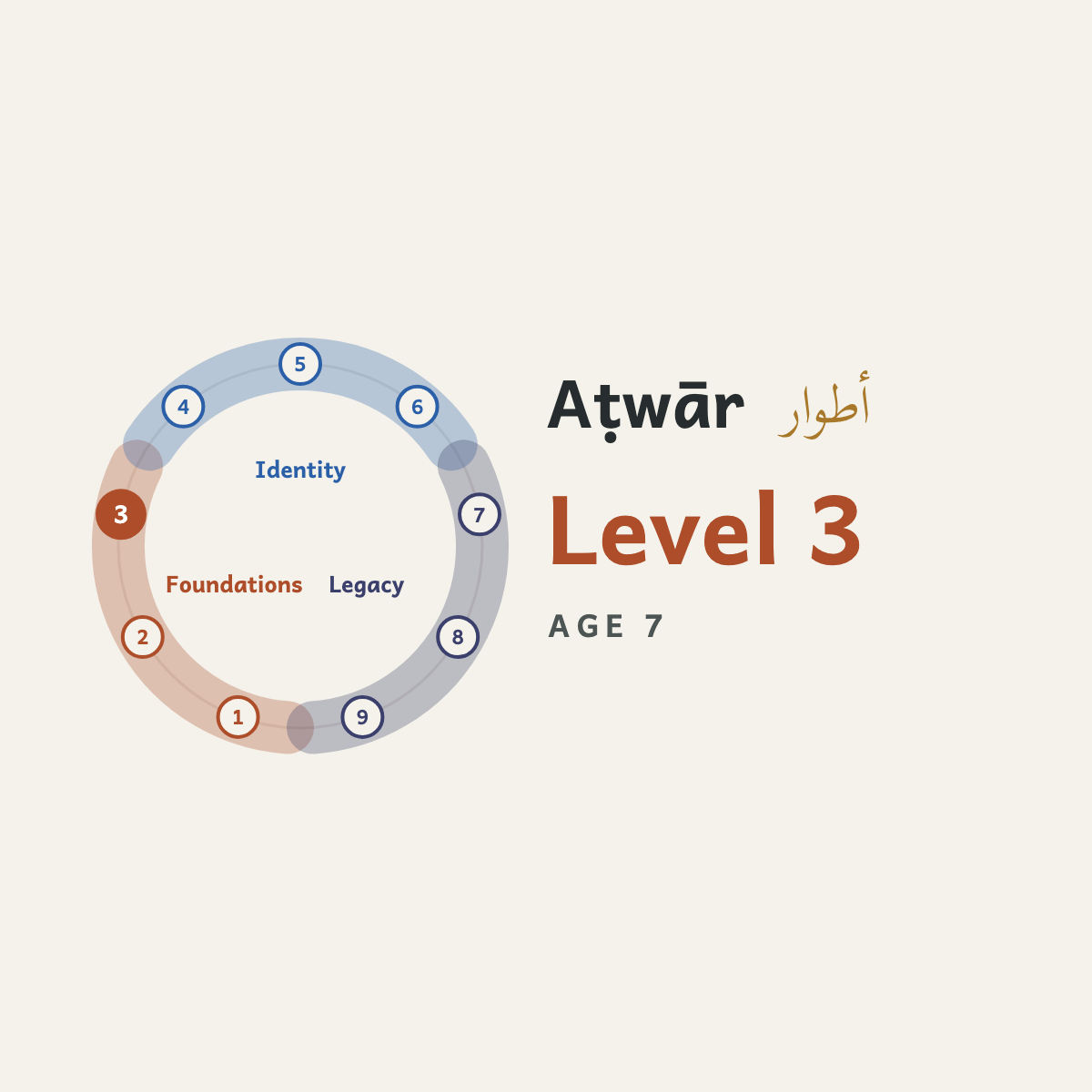
Level 3 focuses on honesty and dependability as seven-year-olds begin taking on independent responsibilities. Through 80 lessons drawn from the Qur'an, it prepares children to ask and answer, “Can I be trusted?” The aim is to build a reliable conscience, helping children keep promises and do the right thing even when no one is watching.
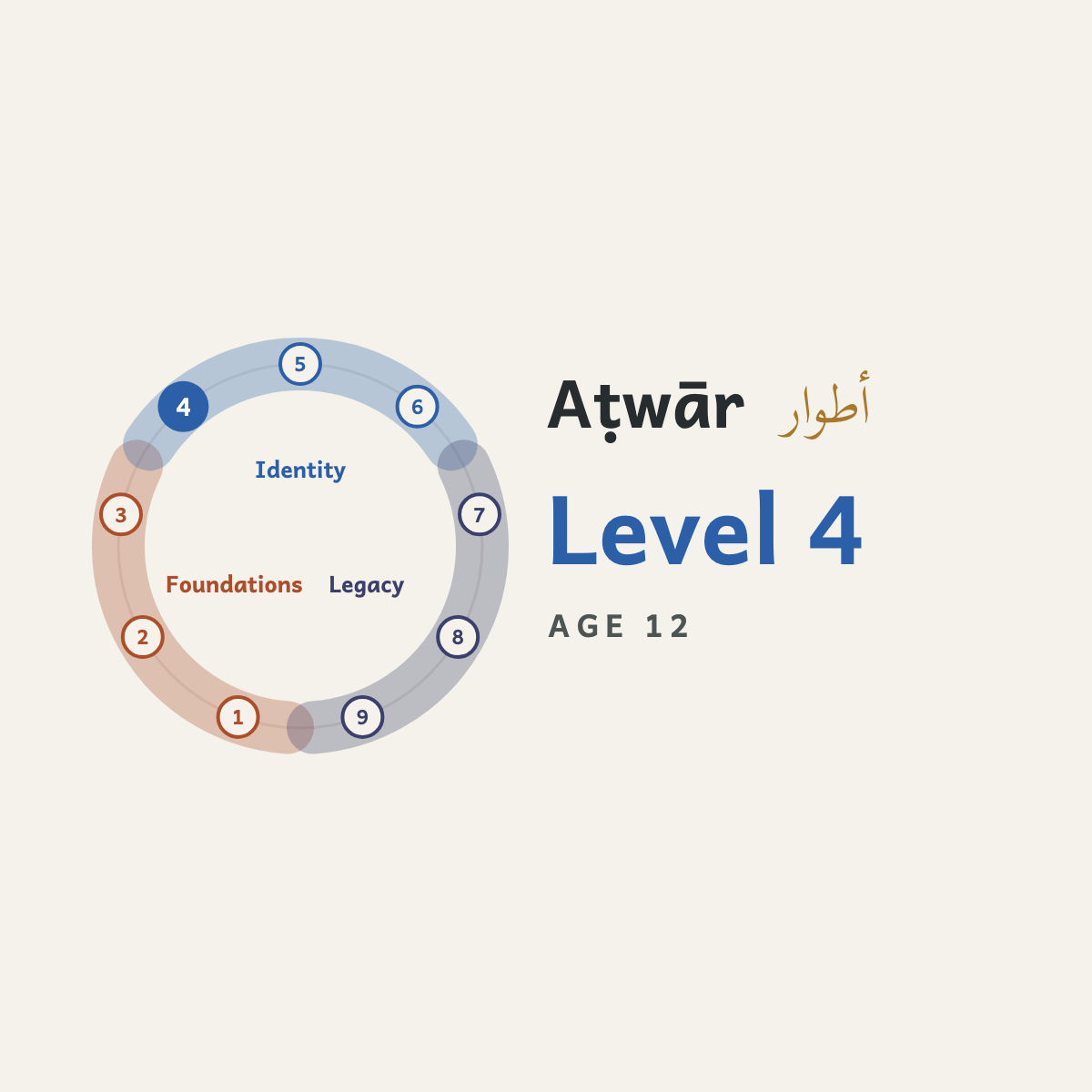
Level 4 meets twelve-year-olds at the onset of adolescence, where peer pressure and social awareness rapidly increase. Across 82 lessons, it guides youth through the essential question, “Who am I when others are watching?” It provides the Qur'anic foundation young teens need to protect their personal boundaries and remain grounded in their values.
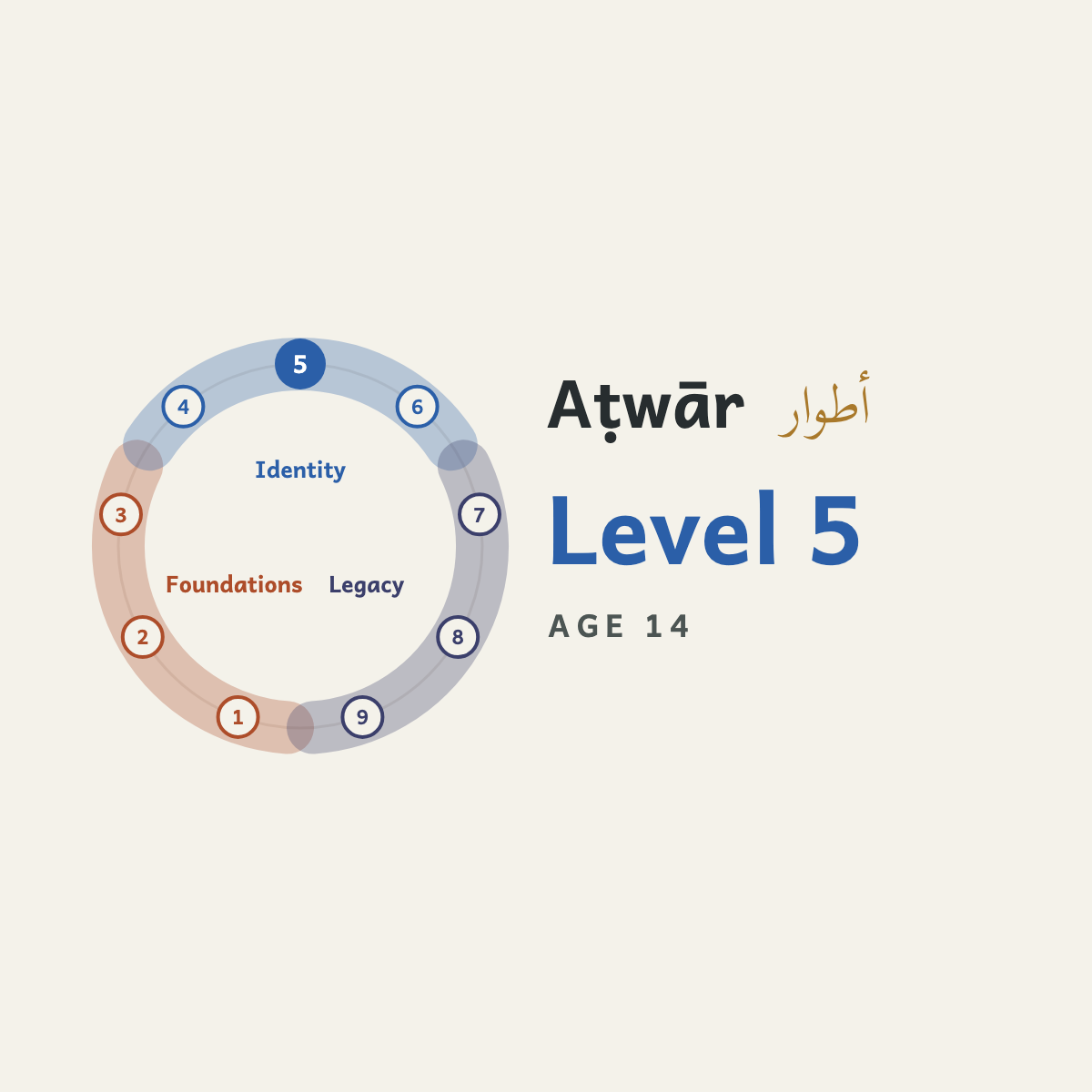
Level 5 helps fourteen-year-olds turn inherited family customs into reasoned, personal faith. Spanning 82 lessons, it challenges students to answer, “What do I stand for, and can I show why?” The curriculum prepares teenagers to articulate Islamic principles with clarity and hold their convictions with confidence.
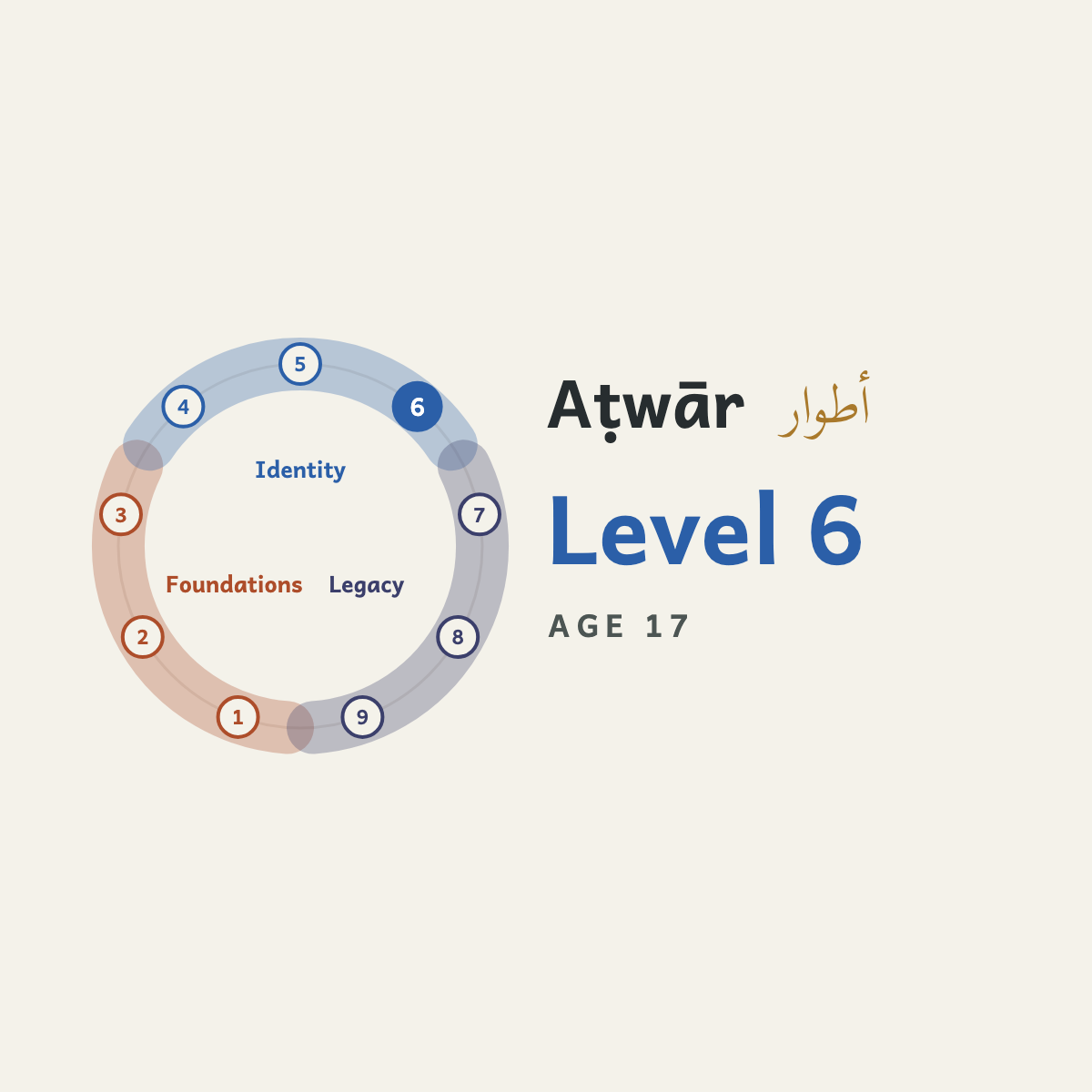
Level 6 is crafted for seventeen-year-olds stepping over the threshold into moral adulthood. Over 84 lessons, it addresses the core question, “What am I now responsible for?” It is designed to move young people from reliance on parents to active, disciplined ownership of their faith, time, and choices.
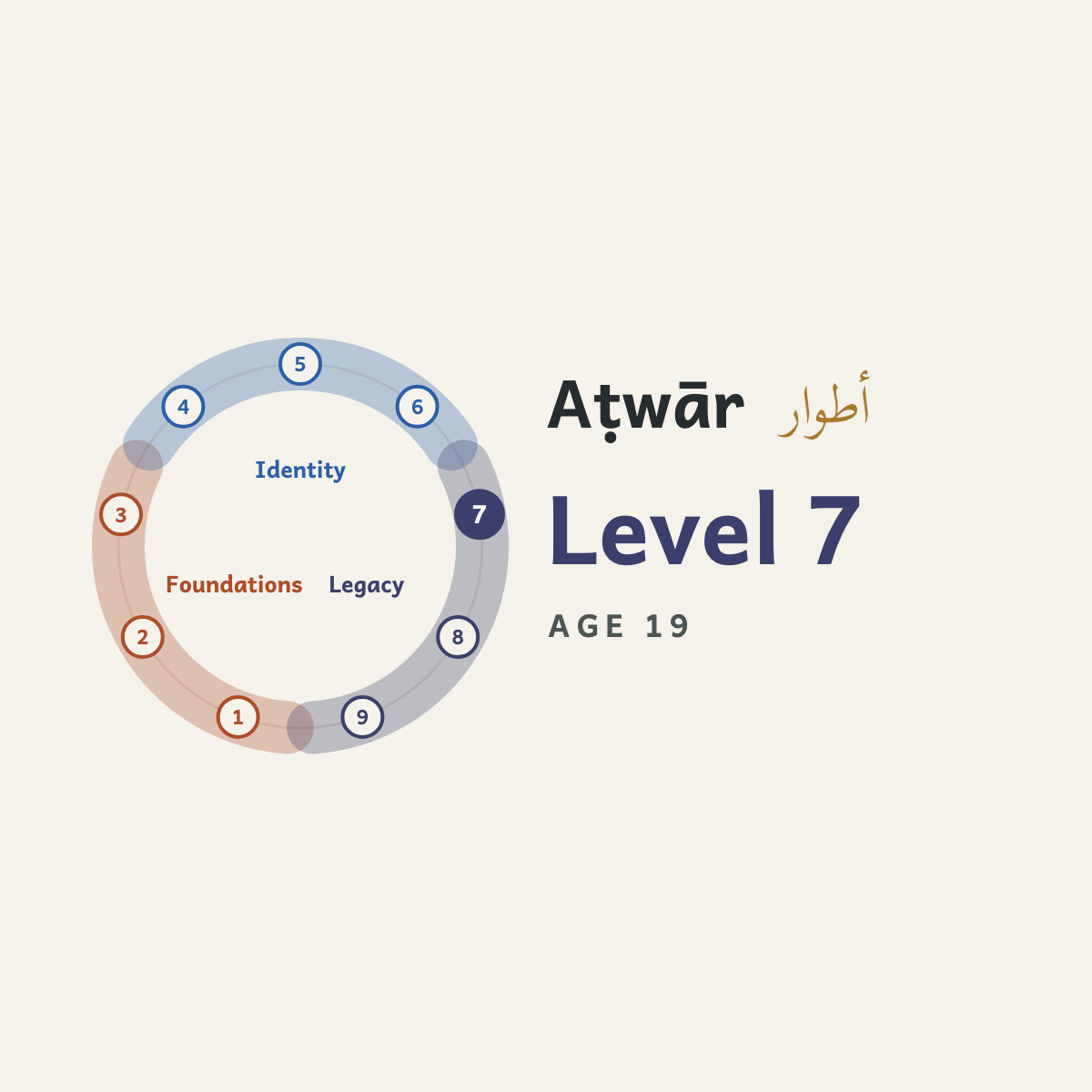
Level 7 supports nineteen-year-olds making the major decisions that will shape their adult lives. Across 84 lessons, it directs students to answer, “Who will I become, and with whom?” It focuses on choosing life paths, enduring friendships, and future marriage partners with spiritual maturity and clear purpose.
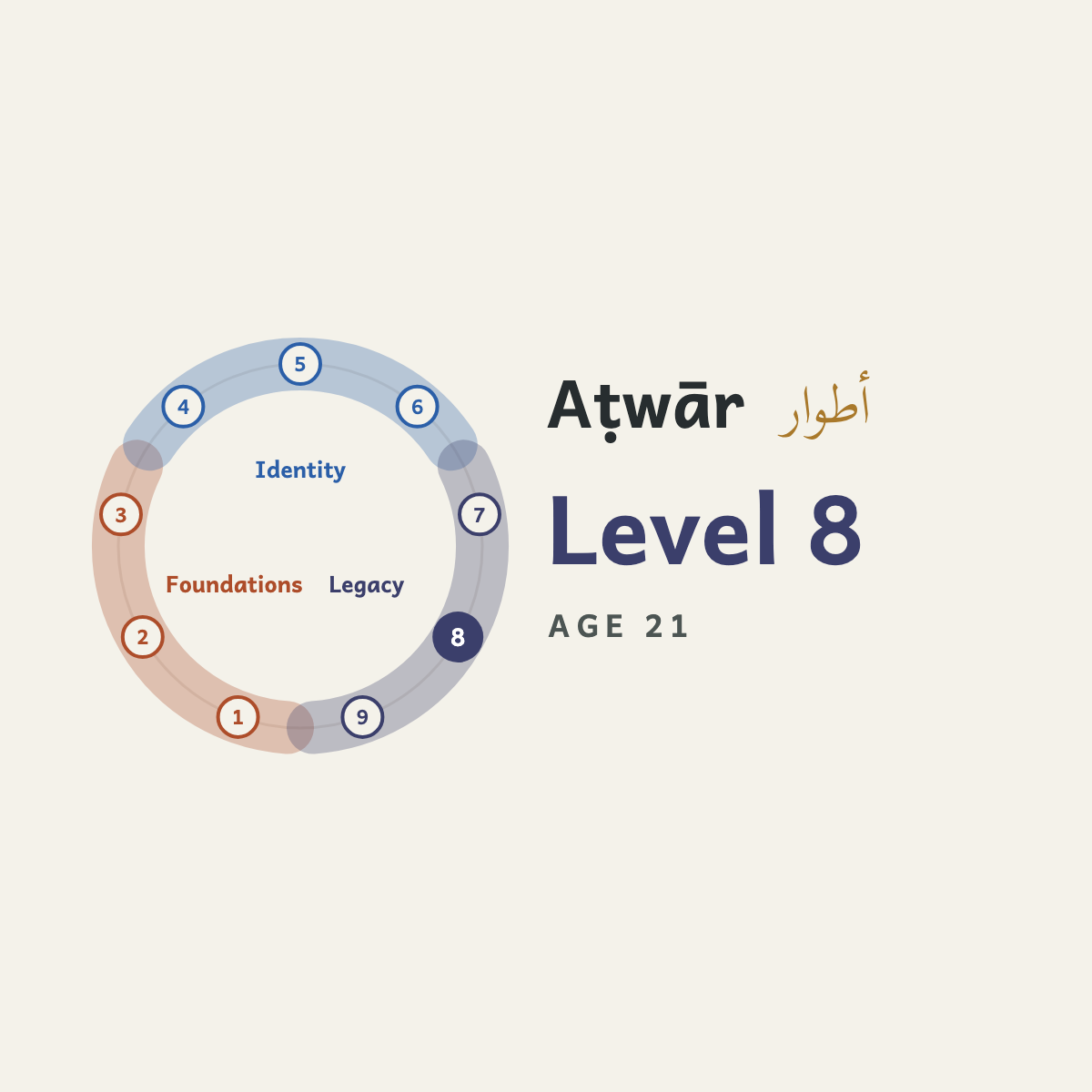
Level 8 is built for twenty-one-year-olds facing the demands of the workplace and the distractions of early adult life. Across 84 lessons, it addresses the urgent question, “How do I build without losing my soul?” The course provides the spiritual stamina needed to pursue worldly excellence while keeping heart and worship intact.
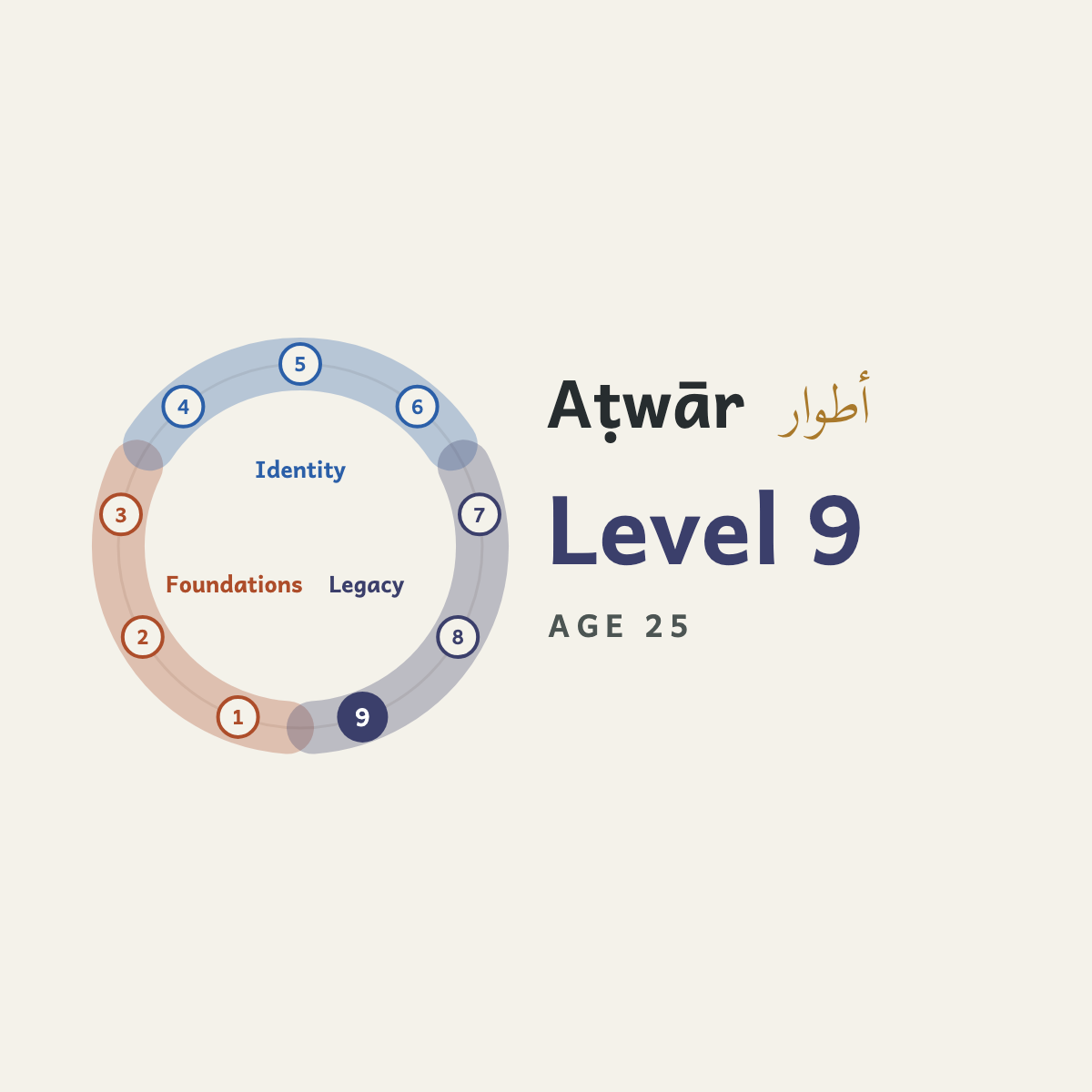
Level 9 meets twenty-five-year-olds as they settle into mature adulthood and look toward the future. Over 84 lessons, this culminating stage centers on the question, “What will I hand on?” It prepares adults to turn their life’s work, character, and resources into lasting benefit for their families and communities.
This course teaches washing hands before eating and after the bathroom. It explains how healthy foods help the body. It also covers taking care of the body so the eyes, ears, nose, tongue, and skin keep working well.
This course teaches foundational habits for personal wellness, everyday safety, and self-protection. Every lesson pairs a short illustrated reading read aloud with a ten-question quiz. Students learn how to care for their bodies, avoid common hazards, and ask trusted adults for help.
This course teaches why sleep matters and how much is enough, along with screen time. It also covers staying safe on roads as a walker and a bike rider.
This course introduces needs and wants, along with goods and services and which ones meet a need or a want. Students learn why people agree to trade. The class also explores weighing the good and the bad of a choice together as a group.
This course teaches how people make choices, trade, and share. Every lesson is a short, illustrated reading read aloud, followed by a short quiz. Students learn about honest business and good character through stories of Muslim families from many backgrounds.
This course explains what lets something be used as money and the concept of opportunity cost, which is the next best choice a person gives up when they choose. Students explore picking the best of several choices to reach a goal and saying why.
This course teaches that every good or service takes resources to make and no one can make an unlimited amount. Students learn about the short term and long term results of choices and that not everyone has the same choices. The material also covers how people are both buyers and sellers, and how businesses are both sellers and buyers.
This course details how natural resources are limited, so people decide how to use them. Students look at how rewards and costs change people's decisions and what makes workers and tools more productive. The topics also include how a country's resources shape what it makes and why different places choose differently.
This course examines choices made in history and what they cost. It explains profit, which is what a business earns minus what it spends, and how the well being of each person and of a whole community are tied together. Students also discover how a government's trade decisions affect people differently.
This course explores kinds of income and how learning and skills affect what people earn. Students learn about making a monthly budget and why companies move work to other places. The material also shows how goods, services, resources and money move through markets in a town, a country and the world.
This course reviews weighing costs and benefits in decisions from United States history and ways to share out goods when there is not enough. Students learn how people and communities can value different things when they face the same choices. The class explores how profit can lead businesses to good inventions and also to harm, and who gains and who loses from a trade policy.
This course discusses traditional, command, mixed and market economies, their goals, and how each affects people's lives. It outlines how choices by buyers, businesses and governments affect a whole society, what makes an economy grow, and why living standards differ between and within countries. Students see how trade between countries gets people goods they could not make for themselves.
Taught by a teacher using reading and project pages, students write and test JavaScript programs in the browser for projects in their grade, and there is no quiz, score, or grade in the course. The teacher shows a saved answer from an AI helper for students to test whether it is right, but no student uses an AI. Teachers get teaching guides, worked solutions, and downloads.
Coding With AI — Grade 7
This course teaches students to write JavaScript in the browser to build a working quiz engine. They will use code to check whether saved AI answers are correct.
This course teaches students to write JavaScript in the browser to build a rain desk that explores fictional school weather observations. Students also learn to test saved answers from an artificial intelligence helper.
This course teaches students to write JavaScript in a web browser to build an app for a school equipment library. They learn to test if code works by checking saved AI answers.
This course teaches students to write JavaScript in the browser to train and evaluate a light signal classifier for a fictional stage crew. They also use code to test saved AI answers shown by the teacher without ever using an AI themselves.
This course teaches students to write JavaScript in the browser to deliver a collaborative stage cue scheduling service and test whether saved AI answers are correct.
This course teaches students to write JavaScript in the browser to deliver a community makerspace seat allocation tool. They also test whether saved AI answers are correct.